Sunday, August 31, 2008

Visual Kei

Visual Kei refers to a movement among Japanese musicians, that is characterized by the use of eccentric, sometimes flamboyant looks. This usually involves striking make-up, unusual hair styles and elaborate costumes, often, but not always, coupled with androgynous aesthetics.

Some sources state that Visual Kei refers to a music genre, or to a sub-genre of J-rock (a term referring to Japanese rock in general), with its own particular sound, related to glam-rock, punk and metal.

However most insider sources state that Visual Kei's unique clothing and make-up fashions, and participation in the related sub-culture, is equally as important as the sound of the music itself in the use of the term as while similarities can be drawn between some bands; most are from widely different genres including but not limited to Pop, power metal, classical, rap, electronic, and death metal.

Visual Kei emerged in the late 1980s, pioneered by the band X Japan., along with others such as D'erlanger and Color, who are regarded as influencing the fashion and music associated with Visual Kei bands. X Japan's drummer Yoshiki Hayashi used the term to describe the band's slogan "Psychedelic Violence Crime of Visual Shock".


Color vocalist "Dynamite Tommy" formed his record company Free-Will in 1986, which has been a major contributor in spreading modern Visual Kei outside Japan. In 1992, X Japan launched an attempt to enter the European and American markets, but it would take another 8 years until popularity and awareness of Visual Kei bands would extend worldwide.


In the mid 1990s, Visual Kei received an increase in popularity throughout Japan, when album sales from Visual Kei bands started to reach record numbers. The most notable bands to achieve success during this period included, X Japan, Glay, Luna Sea, and L'Arc-en-Ciel, however a drastic change in their appearance accompanied their success.

During the same period, bands such as Kuroyume, Malice Mizer, and Penicillin, gained mainstream awareness, although they were not as commercially successful. By 1999, mainstream popularity in Visual Kei was declining, X Japan had disbanded, and the death of lead guitarist Hideto Matsumoto in 1998 had denied fans a possible reunion.


It wasn't long before Luna Sea decided to disband in the year 2000, and L'Arc-en-Ciel went on a hiatus the same year. In 2007 the genre has been revitalized, as Luna Sea performed a one-off performance, and X Japan reunited for a new single and a world tour. With these developments, Visual Kei bands enjoyed a boost in public awareness, described by the media as "Neo-Visual Kei". (wikipedia)

Harajuku Style

Harajuku became famous in the 1980's due to the large numbers of street performers and widly dressed teens who gathered there on Sunday when Omotesando was close to traffic.

Harajuku style is a Japanese Street Fashion adopted by the teenagers and young adults in the area and its side streets which have many boutiques, trendy stores and used clothes shops.
Japanese Harajuku and Harajuku Style has been used to describe teens dressed in many fashion style ranging from Gothic (also gothic loli), Visual Kei, Ganguro, Kogal, to "cute" Kawaii style clothing. Harajuku lovers may also be dressed as anime or manga characters or the movies (known as Cosplay - Costume play).


Harajuku is a popular iconic location in the entertainment world, both inside and outside of Japan. The girls of Harajuku have been said to be the "Star beauty of Japan".

The American singer Gwen Stefani references Harajuku in several of her songs and incorporates four female dancers dressed like Americanised Harajuku Girls into her background act. A song is even dedicated on her album, Love.Angel.Music.Baby, titled 'Harajuku Girls' is depicted on the stage surface during her music video for Hollaback girl.

Her use - what critics call her appropriation - of Harajuku girls and Harajuku fashion has been criticized by many Asian-Americans for perpetuating stereotypes of submissive Asian women. In 2006, Stefani launched a second clothing line called "Harajuku Lovers," said to be inspired directly by Japan's Harajuku district. Harajuku is also used as an avatar style for new registrants to the popular online world Second Life.

The focal point of Harajuku's teenage culture is Takeshita Dori (Takeshita Street) and its side streets, which are lined by many trendy shops, fashion boutiques, used clothes stores, crepe stands and fast food outlets geared towards the fashion and trend conscious teens.

However, Harajuku is not only about teenage culture and shopping. Meiji Shrine, one of Tokyo's major shrines, is located just west of the railway tracks in a large green oasis shared with Yoyogi Park, a spacious public park. Beautiful ukiyo-e paintings are exhibited in the small Ota Memorial Museum of Art.

Sunday, June 22, 2008

Reese Witherspoon's Tokyo Tea

Photobucket
Actress Reese Witherspoon enjoys taking part in a traditional Japanese tea ceremony, an activity thought to capture the spirit of healing the mind, body and soul.

Hollywood leading lady Reese Witherspoon was recently in Japan promoting breast cancer awareness as an Avon Global Ambassador. While in Tokyo she had the opportunity to participate in an intimate tea ceremony with breast cancer survivors, dressed in an beautiful powder blue kimono by Midori Yogi, who's family has dressed the Imperial Family for weddings since 1952.

Photobucket
I just wanted to share this beautiful kimono with everyone. I think the wistful color and playful design suited her perfectly.

As an after thought, isin't it slightly disappointing that even members of the Imperial Family can't dress themselves in kimono?

Why does it have to be so difficult? (>.<)


Friday, June 20, 2008

Pontocho Maiko : Spring 2008

Kyoto Rewind : April 6, 2008

Photobucket
Ichiemi, now a high ranking maiko in the Pontocho district, greets the mistress of a teahouse during a small cherry blossom festival along the Takase Canal.

Photobucket
Ichiemi looks every bit the stylish, sophisticated young woman in this stunning lavender kimono ensemble. Even her adorably child-like cheeks have thinned out.

Photobucket
Ichiharu

Photobucket
The long, fluttering strands cherry blossoms hanging from Shinaju's hanakanzashi, or flowered hair ornament, testify to her low rank and inexperience as a maiko, appealing instead to her youth and child-like charm. Compare it with Ichiharu's above, who is of a slightly higher rank.

Photobucket
Hisano, now a geiko, and Ichiemi walk beneath the lacey veil of cherry blossoms along the Takase canal as sunlight falls in playful patterns along the pavement.


Photobucket
As if Ichiemi's lavendar kimono wasn't enough. Coupled with this remarkable pastel obi, colored with the sweet, pastel pallet of spring, this ensemble quickly became my favorite this season.

Wednesday, June 18, 2008

The 59th Kyo Odori 2008

The maiko Satonami performs in the opening scene with the geiko Chiyoe and Kanachisa.

With the passing of a winter that was more severe than most, the now-greening mountains and perfumed winds seem particularly glorious. In this refreshing season graced by gentle spring sunlight, we are once again proud to present our annual Kyo Odori.

We would like to express our gratitude to all of you who found time in your busy schedules to attend today's performance, which begins with a song-accompanied dance performed by our charming geiko and maiko in a traditional Miyagawa-cho zashiki room. Then performance then goes on to portray in a poetic manner each of the four seasons in Kyoto, with the beauty of the scenes to be found on mountains and in plains depicted through evocative dance.

Much assiduous practice and rehersal has gone into this year's event. After having viewed the fruits of our labor, any comments that you might have on our performance would be greatly appreciated...

I hereby express, on behalf of everyone at the Miyagawa-cho Kabukai, the sincere hope that you enjoy the wonderful spectacle that is the 59th Kyo Odori.

(Excerpt from the Kyo Odori Program)

From left to right, maiko Kimiha, Satonami, and Miyoharu.

Photobucket
The maiko Satonami.

Photobucket
The maiko Tanewaka performs "A Brilliant Brocade of Chrysanthemums".

Photobucket
Kimiharu, little sister to one of Kyoto's most popular and beautiful maiko, Kimika.

Photobucket
Kikutsuru performs in Kyo Odori for the first time as a geiko after turning her collar in June of 2007.

Photobucket
In a scene from the Tale of Genji, the geiko Fumimari dances in Heian period robes as Ukifune.

Photobucket
The celebrated dancer Fumicho performs her solo, a constant in the Kyo Odori program.

Photobucket
The geiko Chizuru as an Edo period courtesean in "The Tale of Princess Takiyasha".

Maiko take center stage in a brilliant display of color, beauty, and grace during the Miyagawa-cho Ondo Song and Dance.

Tuesday, June 3, 2008

Finding the Philosopher's Path

Kyoto Rewind 2008: April 3, 2008

A view of the great gate of Nanzen-ji through a lacey veil of cherry blossoms. Nanzen-ji, or the Southern Mountain Temple, is thought to be the most famous and important Zen temple in the world.

Located just outside of Heian Shrine, Okazaki Canal connects the Lake Biwa Canal network with the Kamo River.

A ride on a the canal is a great way to view the cherry blossoms.

Walking the streets of Kyoto, somewhere in between the grounds of Nanzen-ji and the Philosopher's Path.

This stoney, sakura-lined path leads to the gate of a private residence we stumbled upon as we wandered towards the Philosopher's Path.
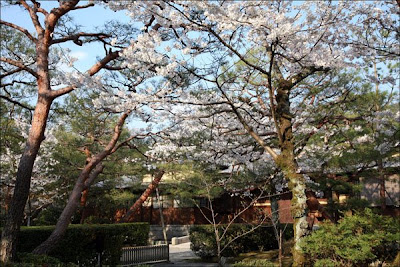
The entire estate was well hidden, surrounded by a wall offering only a glimpse of gardeners grooming the highest branches of the pine trees, shaded by magnificent clouds of cherry blossoms.

Peaking over the low hedges encircling the entrance.

Bamboo blinds and cherry blossoms provide shade and shelter.

The philosopher himself!

Absolutely one of the best places for hanami I've experienced so far. Highly recommended!

A young girl in kimono smiles beneath the canopy of blossoms covering the path.

A couple admires the blossoms.

The palette of spring paints the Philosopher's Path is subtle shades of pink, green and yellow. Light filters through the intricate lace of cherry blossoms, falling like the brush strokes of an impressionist masterpiece. Is it really any wonder I love Kyoto?

Sunday, June 1, 2008

Evening Tayuu Procession

Kyoto Rewind: April 2, 2008

Photobucket
Kisaragi Tayuu ducks into a ryotei, a traditional dining establishment, along Kiyamachi-dori.

The perfect way to end an incredibly Kyoto-culture packed day of exploring Kiyomizu-dera and hanging out with maiko was with an extremely rare evening procession of Tayuu beneath the cherry blossoms.

As Peter MacIntosh explains on the Kyoto Sights & Nights website:

"Since medieval times Japan has always had some form of pleasure quarter offering various forms of entertainment, including, of course, the erotic. However, it was during the Edo period’s sakoku (1639-1854) when Japan cut off all ties with the outside world, that Japanese culture, as it is known today, flourished.

It was in these walled-in pleasure quarters such as Kyoto’s Shimabara, Tokyo’s Yoshiwara, and Osaka’s Shinmachi that the chonin (merchants) spent much of their time and money cultivating the arts."


Photobucket

Spurned as the lowest class of citizen in the feudal Japanese heirarchy, merchants were seen as blood-thirsty parasites leeching off the hard work of others. Their wealth could not buy them respect or equaliy, except within the walls of the pleasure quarters, where, for the right price, they would be treated and entertained like kings.

"The courtesans of the pleasure quarters were trained in various arts: music, dance and poetry as well as other forms of entertainment that up until that time had been known only to the nobility. As times changed so did the tastes of the customers. The formality and expense involved meant that only the elite were able to patronize the Tayu (the top level courtesans). "

Photobucket
An apprentice Tayuu bundled beneath a bright red blanket as she arrives by riksha.

Liza Dalby describes the "Great Court Ladies", as Tayuu were known, in legendary proportions:

"These women were dubbed "castle-destroyers" (keisei) because their sex appeal, like the mythical beauties of history, could destroy a man as easily as any army. These courtesans wore layers of ornately decorated kimono and a multitude of lacquer and tortoiseshell combs in their hair. Their wide, brocaded obi were tied in front — not, as some suppose, because it was easier to undress that way, but because that was the practice of married women and a yuujo was, in a sense, a wife for an evening. "

Photobucket
Kisaragi's obi is tied in front in the style of a full-fledged Tayuu.

Photobucket
As an apprentice, her obi is tied in a bow.

As times changed, so did the tastes of their patrons. The flashy appearance and antiquated customs of the Tayuu began to loose their allure, and when the first female geisha appeared on the scene in the 1700's, it marked the begining of the end. The last recorded Oiran (as Tayuu were known in Edo) served in 1761. Only in Kyoto do a few women continue to practice and preserve the cultural arts of the Tayuu.

Photobucket
The full regalia of a Tayuu weighs about 30 Kilos.In addition, they also wear tall, black lacquered koma-geta (wooden clogs) with three legs. Even in winter, Tayuu refrain from wearing the white, fitted tabi socks that geiko and maiko wear. This tiny hint of bare flesh peaking out from beneath the many layers of her luxorious silk kimono must have been very appealing to a Tayuu's Edo period patrons.

The towering "three leg" geta of the Tayuu.

Photobucket
As if balancing beneath the burden of their elaborate costume on 12-15 inch platforms is not enough, Tayuu walk in what is often called a "figure eight" fashion, sliding one foot out slowly in an arch away from the other before drawing it back to center. Pausing with her bare foot exposed from beneath her crimson kimono, almost perpendicular to the other, she then points her foot forward and begins again. It takes a great amount of skill, balance, and practice to perfect, and they often hold the hands of their chaperone to help.

Photobucket
Kisaragi Tayuu holds the hand of her chaperone as she makes her way through the crowd.