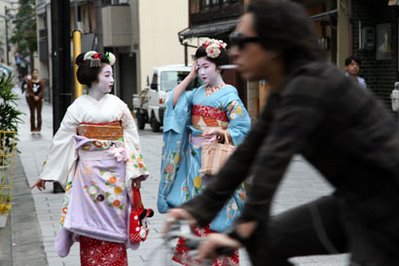
Kimika and Satoai. Check out Kimika's Minnie Mouse purse (^-^) The epitome of traditional Japanese style.
Goro goro goro goro... The unmistakeable sound of a wooden door sliding open. Whenever I find myself strolling through a hanamachi (flower town, where geiko live and entertain), my senses are heightened and alert. Even simple sounds that usually blend into the indistiguishable hum of everday life in Japan, become melodious, distinct, and full of meaning.
Kobo kobo kobo kobo... Before I could even turn around I heard the soft, giggling voices of two girls and the clop of their tall, hollowed wooden sandals (called Okobo, because of the sound they make) stepping out onto the cement. As I looked over my shoulder, two beautifully dressed maiko came to a stop at busy corner, trying to decide which way to go. The cars and bicyclists, oblivious or uninterested, passed them by without so much as a second glance, but I couldn't take my eyes off them. Behind them a young minarai (apprentice maiko) stood in the street, respectfully seeing her big sisters off. I recognized Kimika (on the left) who has the reputation of being one of the most beautiful maiko in Miyagawa-cho, and was recently featured in Kateigoho Magazine. I watched them turn the corner and disappear, and even after found myself straining to hear the kobo kobo sound of their footsteps fading away. When I came to, I noticed a cute little Japanese woman smiling at me, sweeping the pavement infront of her machiya (townhouse).
"Konnichiwa," I smiled back with a little bow.
"Kawaii, ne? Nihon no maiko-san..." (Cute, aren't they? Japan's maiko)?
"So cute! Beautiful! They're like living works of art. Their hair, their kimono, their make-up, and the way they move... Like a dream!"
"Yes, but it's very difficult, you know. They come from very far away and study very hard. And how about you? You've come quite a way haven't you? Where are you from?"
"America. The State of Ohio. Ohaiyo!" I smiled cheesily and waved my hands in typical school girl fashion (Ohaiyo means 'good morning/ hello' in Japanese).
"Oh, really? Ohio." She said as she laughed at me. "You know, my big sister went to America before. Oh, if she was home I bet she'd love to talk to you. Are you a student? Are you studying abroad? How amazing that you can speak Japanese so well! It's amazing!"
"Actually, I'm an English teacher in Gifu prefecture," I giggled. I get the student thing a lot (I'm not complaining)! "And my Japanese is horrible! I don't study at all...But Thank you for saying so." We stood in the street talking for quite awhile, and eventually she mention that she was 80 years old. 80 years old?! The woman did not look at day over 60, and a young sixty at that. Now that is amazing. It got me thinking, just how old was her big sister?
Yasuha and Fukuyoshi.
As we stood in the street, maiko continued to hurry by. Incapable of hiding my excitement, I fumbled akwardly to get my camera untangled from my neck and bag before they hurried past us. "Oh, that's good!" She said. "We'll take a picture!"
"What? No, no, that's Ok! They're busy and..."
Before I could refuse she was already calling to Yasuha, by name. To my suprise, Yasuha greeted her with a big smile, a bow and bubbley "Konnichiwa Okaasaan!" The little old woman asked her if she could take our picture, directed Yasuha to stand in front of a teahouse across the street, and pushed me over to her as she grabbed my camera out of my hands.
Yasuha and I (^-^)v
I apologized and thanked Yasuha about 3 times in one breath, even as I tried to smile for the picture. "Hai cheeezu!" She called out. "Ah! That one was no good. One more! Hai Cheezu! Ok!"
I started to apologize and thank Yasuha all over again, but she smiled, bowed to me, said "Ookini" (thank you in Kyoto dialect).

As Yasuha walked up the street, a little old woman leaning on her cane came around the corner. Yasuha greeted her and bowed, stopping in her steps and turning to face the old woman as she slowly hobbled on by. "Oh! Here she is! This is my big sister. Big sister! This cute little sister is from America! It's amazing. She can speak English and Japanese!"
The big sister, who turned out to be 84, slowly made her way to me with a beautiful smile spread across her softly wrinkled face. She asked me where I was from and if I was a student, and then we began to talk about her trips to America at least 40 years ago. She had been to L.A., San Fransisco, Las Vegas and the Grand Canyon. "It was amazing. I had never seen so many fruits. Such beautiful fruit!"
"Really?" I asked "Was the fruit delicious?"
"Oh, I don't know...I never got to eat any. I was with a customer. You know we can't eat when we're with a customer like that. But I remember thinking, "What beautiful fruit!" I had never seen anything like that before!"
The maiko were still making there way back and forth, calling at okiyas and hurrying to get to the recital practice. All of them greeted this wonderful little woman with deep bows of respect and sweet sounding "Konnichiwa Okaasaan!" and then would smile at me a give a little bow. She often asked them to stop for me to take a picture, or tried to talk to them long enough until I seemed satisfied with the shot I had. "Did you get it?" She asked when they would clop clop away down the little alley just next to her home.

We talked for quite awhile before she called for her little sister to bring something out for me. She emerged, hiding her smile behind a classic Gion Matsuri uchiwa (Japanese style fan) with the name of Miyagawa's most acclaimed dancer written elegantly beside the crest of the hanamachi. She place a "Sakura-ya" sticker (name card, like geiko use) near the base of the smooth wooden handle. "This is my place. Sakura-ya." I thanked her profusely before she slipped into the sliding door of her home, content with the events of the day and the experience they had brought me. It wasn't even noon yet.
 Miyoharu and Fukuhina outside their okiya. Conveniently placed, ubiquitous vending machines.


 Kimika and Satoai. Check out Kimika's Minnie Mouse purse (^-^) The epitome of traditional Japanese style.


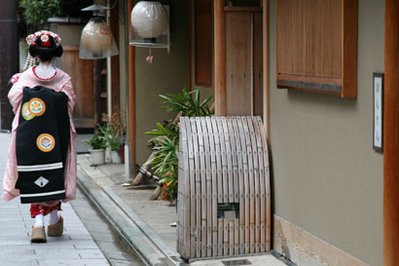 With October drawing to an end, I was determined to make a quick trek to Kyoto to secure tickets for Gion Odori, Gion Higashi's fall dance recital. I hadn't been to Kyoto since Gion Matsuri, and after three months I was itching for an excuse to get back.

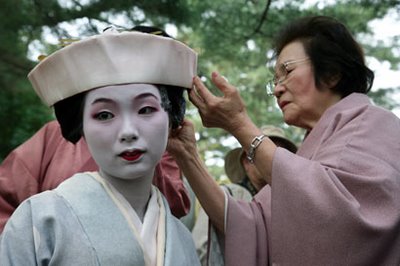
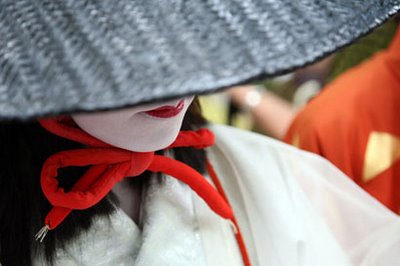 Jidai Matsuri, Kyoto`s Festival of Ages, started as a way to revitalize Kyoto after Japan's capitol moved to Tokyo. It has now grown to include over two thousand participants (Kyoto residents, including Maiko and Geiko) dressed in authentic period costumes from throughout Japan`s history valued at over $25 million.