


 Memoirs of a Geisha opens today in Japan! Finally I will get to see a movie before everyone back home!
Saturday, December 10, 2005

Sunday, December 4, 2005
Fall In Gion: Gion Odori

Tsunesono, a geiko of Gion, strikes a feminie pose characteristic of Kyomai, Kyoto's traditional style of dance.

Two geiko Gion of dancing kyomai. The shadow of the geiko Tsuneyu was just too perfect! She was like a porcelain doll.

Tsuneyu, an older geiko, moved so gracefully I couldnt take my eyes off her. Since Tsuneyu and Tusnesono both share the "Tsu" in their names, they must come from the same Okiya, or geisha house. In the flower and willow world, they are sisters.

Tsuneyu flutters her fan during the finale, the Song of Higashi Gion. This shot shows the difference in skill between a geiko and a maiko. Note the position of the hands, the fans, and the way their long sleeves are being held. Take a closer look on Flickr: Tsuneyu つねゆ.

Tsunesono also graced the stage for the final dance, along with all the participating geiko and maiko.
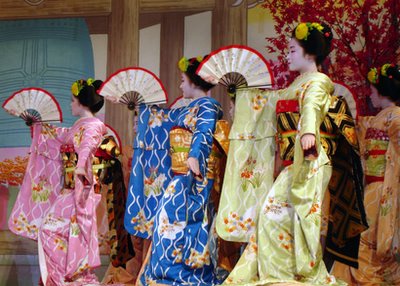 The vivd colors, luxurious silks and elegant design of the maiko's kimonos were breath-taking. These dances transport the audience to a world of ethereal beauty, where every movement is a perfect work of art.
Thursday, December 1, 2005
Big Brother Gaijin's Tips for Traveling Japan

Get rich before you come. Seeing a geisha or maiko walk through Gion is fun and all, but hanging out with them is not cheap!
 If you dont have enough money to hang out with them, at least try to see them dance! (More pictures from the Fall dance coming soon!)
Take advantage of every opportunity to jam! Don`t forget to bring your shamisen!
When climbing an active volcano, ignore all signs warning of danger and forbidding trespass. Take the path less traveled...
...like this one i found wandering through the cow pastures...
Make friends wherever you go.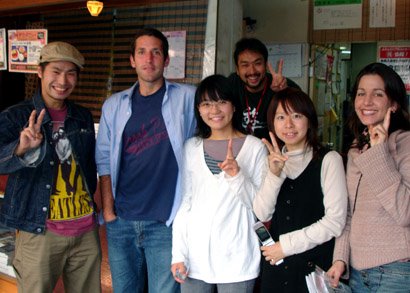 Join a hostelling association before you go, and save yourself some cash flow! This country is expensive!
Pretend not to know the strange person that keeps taking pictures of you.
Get lost in a garden.
Spend as much time as possible in Kyoto. And come in the fall.
If you want to see a Japanese castle, head straight for Himeji!


 Remember: Soba is your friend! Eat it, and eat it often!
 Want a good view of Fuji-san? Climb the nearest electrical or cell phone tower...
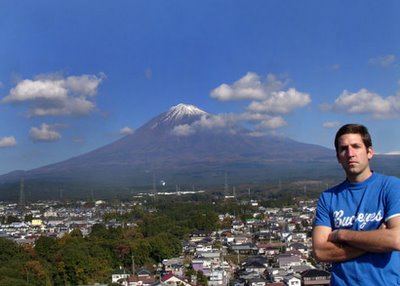 You wont be disappointed! And since you can`t climb Fuji, at least you can say you climbed something!
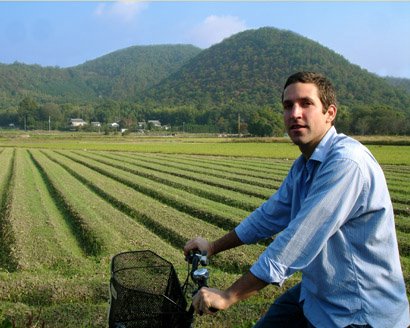 Exploring on bike is your best bet, but dont forget to take time to stop and smell the tea...

Thursday, November 24, 2005
The Book Club's Grand Tour of Kyoto
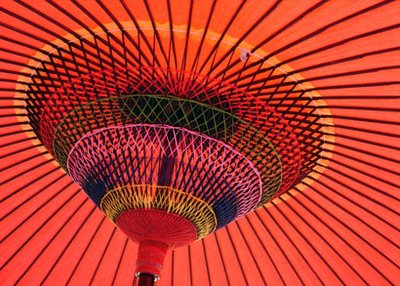 Paper umbrellas popped on the Japanese scene during the Edo period. Featured in many of the woodblock prints of Hiroshige Ando`s '100 scence of everyday life' these wax coated paper umbrella spared the people from the heat of the harsh, summer sun and sheltered them from rain. Utamaro Kitagawa also depicted these traditional umbrellas in his Ukiyoe (woodblock) masterpieces of beautiful women. These days, Japanese umbrellas play an important role in tea ceremony, dance, and Kabuki as an essential representation of Japanese traditional culture.
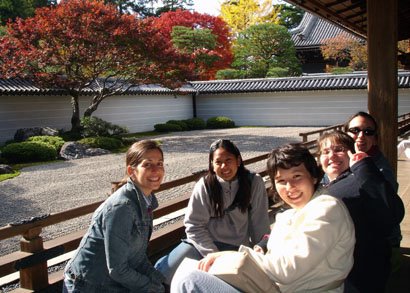 The 'book club' kids pause for a moment of meditation at one of Nanzenji`s rock gardens.
The thick wooden clogs of a maiko, or apprentice geisha. In the crowded Hanamikoji street, we heard the sound of many maiko girls' rushing to make their appointments. 'Kobo-kobo-kobo'is the onomonopia used to describe the sound of these shoes on the stone streets. 'Okobo', as they are called, have extremely thick soles, measuring 11cm.
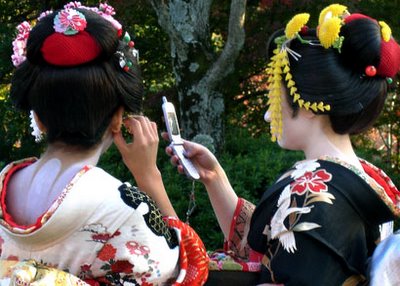 Two nisemono maiko, or imposters (toursits playing dress-up), send pictures of their transformation to friends via keatai, or mobile phone.
A very young maiko steps out with her 'big sister', one of the 17 maiko and geisha we saw walking the streets of Gion.

Another maiko hurrying down the Hanamikoji. Red and green are the 'in' colors this season. Seems even maiko are getting into the holiday spirit.
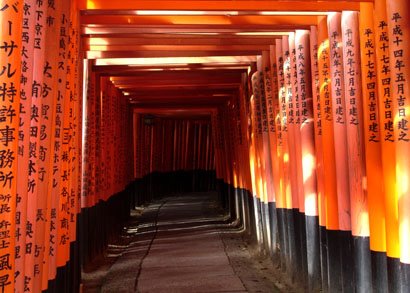 The tangerine tunnel of torii leading through the green trees and autumn leaves of Fushimi Inari.
The changing leaves above Fushimi Inari`s tunnel of torii.
Our trip was coming to an end, but our happy times were just beginning!


Monday, November 21, 2005
Japanese Culture and the Colors of Autumn

The fall colors of Sanzen-In, Kyoto. When the sun rays hit the red leaves and make them glitter warmly, it is called teriha (照葉 [てりは]).
As autumn deepens, the green leaves of deciduous trees begin to set the countryside on fire in shades of red, orange and yellow. This blaze of glory before winter sets in is admired around the world, but only in Japan has "Autumn Leaf Viewing" been ingrained as a popular cultural passtime.
The bright autumnal tints of Kyoto's foliage captivated the hearts of ancient Japanese people, who used them as motifs in literature and art for centuries. Autumn leaf viewing is thought to have become an organized event sometime during the Heian period, when the nobility would gather to listen to music, compose poems, or quietly delight in natures offering. Enjoying the fall colors is as important a traditional past time as viewing the cherry blossoms in the spring, but unlike cherry blossom viewing, which tends to be a rowdy affair, autumn viewing is a time of solitude and reflection.
The maple trees most common to Japan are called Takao maple, or Iroha maple. Takao, the place after which the tree is named, is one of the three famous spots in the foothills of Kyoto's northwestern mountains (together with Makino-o and Togano-o).
Because maples flaunt an especially gorgeous array of colors, one tends to immediately think of the maple as the definitive image of momiji. Its impossible to ignore the beautiful arrdisplay of autumn leaves on other trees, like persimmon trees (柿紅葉 [かきもみじ]), cherry blossom trees (桜紅葉 [さくらもみじ]), lacquer trees (漆紅葉 [うるしもみじ]), and rhododendrons (満天星紅葉 [どうだんもみじ]). Seeing the mixed palette of forest foilage (雑木黄葉 [ぞうきもみじ]) covering the mountains is like studying an impressionist landscape painting.
The trees with the most dramatically vivid autumn colors are found in the mountainous and northern regions of Japan, where there is a severe discrepancy in temperature between day and night. Generally, the leaves start to turn color when the temperature dips under 8 degrees Celcius (approximately 46 degrees Fahrenheit). They reach a climax when the day's lowest temperature hits 5-6 degrees Celcius (approximately 41-43 degrees Fahrenheit).Its all very scientific, and the Japanese keep careful track of these temperature changes in order to forecast where the leaves are changing, and when they will be most beautiful. Every news program devotes a special segment, along with it weather forecast, to an autumn leaves update.
Some trees with leaves that turn yellow rather than red-- such as a type of oak (檪 [くぬぎ] kunugi) or gingko trees (銀杏 [いちょう])-- are also called momiji, although when written with Chinese characters, the form is slightly different. The Chinese character for "yellow" (黄) replaces that of the character for "red" (紅). In that case, momiji is written as "黄葉" (yellow leaves), instead of "紅葉"(red leaves).
As a linguist, I have always believed that the amount of words dealing with a subject, as well as the specific meaning contained in a single utterance help shed light on the cultural importance of the subject. The Japanese language has no shortage of words to describe the leaves of fall. For example, the term kusa momiji (草紅葉 [くさもみじ]) describes the way autumn leaves fall and spread themselves over grass. I wonder if they have a word for a pile of leaves gathered together for the expressed purpose of jumping into them--although I doubt it because, sadly, I've never seen anyone jumping into a pile of freshly raked or hand gathered leaves in Japan! Alas...
Other related terms:
初紅葉 [はつもみじ] hatsumomiji, first momiji
薄紅葉 [うすもみじ], usumomiji, pale momiji
紅葉 【もみじ】 momiji, (もみぢ), red leaves / red (maple) leaves
夕紅葉 【ゆうもみじ】 yūmomiji, evening red leaves
むら紅葉 【むらもみじ】 muramomiji, village's red leaves
谿紅葉 【たにもみじ】 tanimomiji, valley's red leaves
紅葉山 【もみじやま】 momijiyama, red-leaved mountain
紅葉 【もみじ】 momiji, (もみぢ), red leaves / red (maple) leaves
夕紅葉 【ゆうもみじ】 yūmomiji, evening red leaves
むら紅葉 【むらもみじ】 muramomiji, village's red leaves
谿紅葉 【たにもみじ】 tanimomiji, valley's red leaves
紅葉山 【もみじやま】 momijiyama, red-leaved mountain
Thursday, November 17, 2005

Sunday, November 13, 2005
Tenryuji's Fall Foilage 天竜時の紅葉

The leaves at Sagano's Tenryuji (Heavenly Dragon Temple) are early this year, setting the temple gardens on fire in brillant hues of crimson.(Picture taken Nov.1st!)
Subscribe to:
Posts (Atom)


